

Magnesium Sulphate Anhydrous Uses and Applications
Magnesium Sulphate Anhydrous Uses and Applications
Magnesium Sulphate Anhydrous is a water-free inorganic salt with the chemical formula MgSO₄. Because it can bind water and supply magnesium and Sulphate ions, it serves different functions in chemical drying, analytical testing, industrial synthesis, dry-powder processing, feed, and agriculture.
Compared with the familiar heptahydrate form, its main advantage is not simply that it is “drier.” It is a distinct material form for processes that are moisture-sensitive or need to limit the introduction of crystal water.
What Is Magnesium Sulphate Anhydrous?
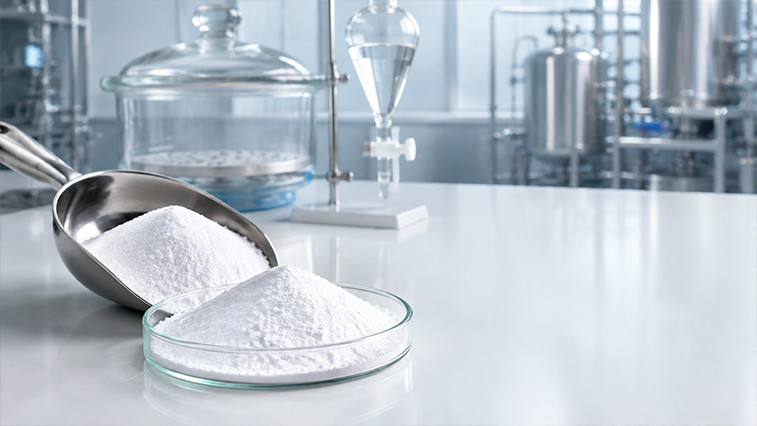
Magnesium Sulphate Anhydrous has the formula MgSO₄ and a molecular weight of approximately 120.368. It contains no crystal water, but it is hygroscopic and can form hydrates after absorbing moisture.
“Anhydrous” describes the chemical form. It does not mean that the material will remain completely free of moisture under every storage condition. Ambient humidity, exposure time, sealing, and process handling can all change its actual moisture state.
Suitability should therefore be assessed through moisture control, purity, particle characteristics, solubility, and compatibility with the intended system.
Why Does the Anhydrous Form Matter?
Four characteristics explain most Magnesium Sulphate Anhydrous uses:
· Water binding and hydration: It can remove residual water from organic phases or sample matrices by forming hydrates.
· Limited introduction of crystal water: This is valuable in moisture-sensitive workups, analytical preparation, and dry blends.
· A soluble source of magnesium and Sulphate: After dissolution, it can supply both ions to chemical, nutritional, or formulation systems.
· Compatibility with dry processing: When particle size and flow meet process requirements, it can be used in dry blending, powder handling, and later dissolution steps.
These properties do not make the anhydrous form universally better than magnesium Sulphate monohydrate or heptahydrate. Hydrate forms differ in dissolution behavior, flow, storage stability, and regulatory identity. The correct form depends on the process objective.

Main Applications of Magnesium Sulphate Anhydrous
1. Organic Solvent Drying and Reaction Workup
The use of magnesium Sulphate as a drying agent is one of its best-known technical applications.
After extraction or reaction workup, an organic phase may retain a small amount of dissolved water. Magnesium Sulphate Anhydrous binds this water, forms hydrates, and can then be separated from the organic solution by filtration.
The appropriate choice still depends on:
· Solvent type;
· Target compound;
· Acid-base sensitivity;
· Downstream reactions;
· Analytical requirements.
Fast drying does not guarantee compatibility with every chemical system.
2. Analytical Testing and Sample Preparation
Magnesium Sulphate Anhydrous is widely used in extraction workflows for pesticide residues, veterinary-drug residues, and other trace analyses.
It can:
· Absorb water from sample matrices;
· Support salting-out;
· Improve aqueous and organic phase separation;
· Facilitate centrifugation and filtration;
· Improve the consistency of instrumental analysis.
In this application, analytical cleanliness, blank background, and method repeatability are critical. A general industrial grade should not automatically be substituted for a material qualified for analytical work.
3. Industrial Synthesis and Dry-Powder Processing
In industrial chemistry, Magnesium Sulphate Anhydrous can function as a soluble magnesium salt, reaction raw material, or process aid.
It supplies magnesium and Sulphate ions to aqueous processes and can also fit dry formulations, dry blending, and later dissolution steps where the introduction of crystal water is undesirable.
For continuous manufacturing, the following properties may affect production stability:
· Actual moisture condition;
· Particle-size distribution;
· Powder flow;
· Caking tendency;
· Insoluble matter;
· Compatibility with other formulation components.
These characteristics can influence feeding stability, blend uniformity, and conveying performance. The benefit of the anhydrous form should therefore be evaluated within the full process window rather than from the chemical name alone.
4. Feed Mineral Material
Where permitted by the applicable market and standard, feed-grade Magnesium Sulphate Anhydrous can serve as a mineral source of magnesium and sulfur.
Feed use requires the grade specified by local feed rules and relevant contaminant controls. Industrial, analytical, and feed grades are not interchangeable merely because they share the same chemical formula.
5. Magnesium and Sulfur Nutrition in Agriculture
Magnesium Sulphate can supply crops with soluble magnesium and sulfur.
Magnesium is associated with chlorophyll and several physiological processes, while sulfur contributes to protein formation and enzyme systems. The anhydrous form can be one raw-material option for water-soluble fertilizers, nutrient solutions, or dry fertilizer blends.
Agricultural use should be guided by:
· Soil or plant testing;
· Crop requirements;
· Water quality;
· Soil conditions;
· Formulation compatibility.
Magnesium Sulphate is not a universal remedy for every crop problem.